
02 — Technology
The membrane is the
whole argument.
Everything we build hangs off one thing: a multi-purpose nano-sieving membrane that we developed ourselves. Everything around it exists to protect that element, keep it clean, and keep it working.
Four in-house processes
40+ patents and IP rights
2 national research projects
Separation, not straining.
A conventional filter pushes contaminated fluid through a screen and keeps what it catches. A membrane separates at the molecular scale: what passes is a different fluid, not merely a clearer version of the same one.
Feed
Oil or process fluid drawn from the sump, tank or line. Pre-filtered, then brought to the working temperature so viscosity does not quietly set the throughput.
Element
The nano-sieving membrane, held between a porous support and a back plate. This is the only place where separation happens.
Permeate
Refined fluid, free of the retained fraction and ready to return to service or to be re-blended.
Concentrate
The retained stream — water, acids, wear metal, degraded additives. Collected for disposal or for recovery.
Four processes that all run
in the same housing.
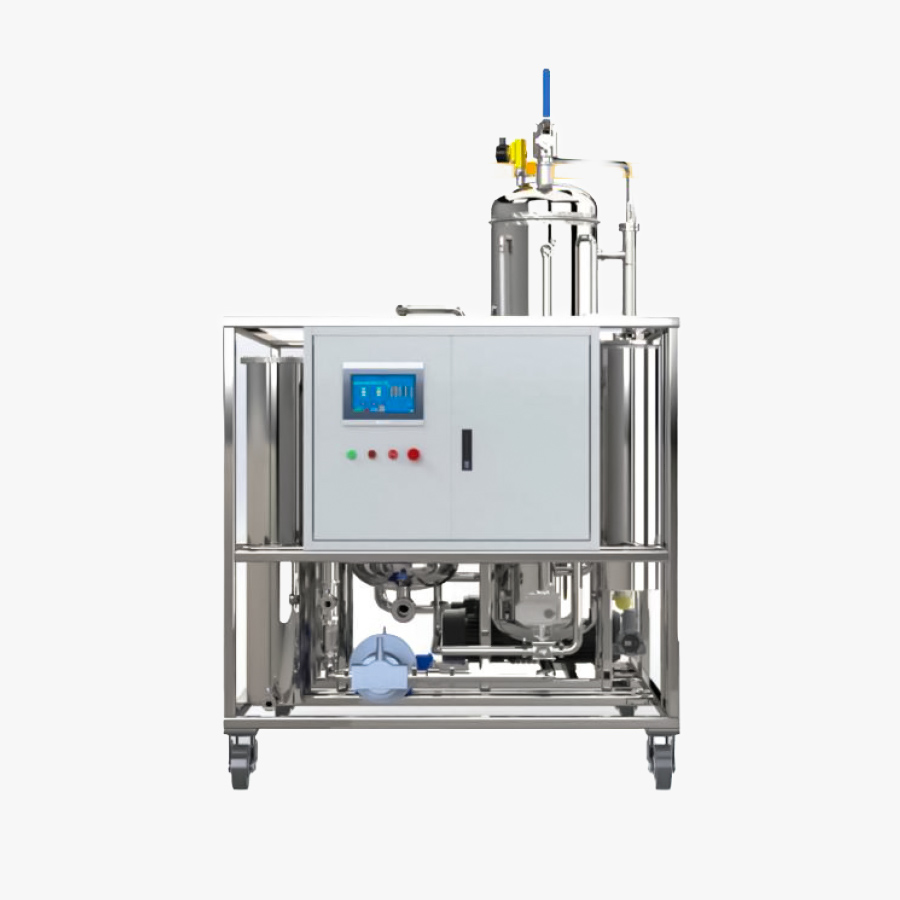
Combining them in one circuit is what makes the consumable cost of a Fengming Huanyu line close to zero, and the turnaround close to nothing.
Graphene nano-sieving
Separation down to 50 and 100 nm across a graphene-based membrane element. This is the process that sets the cleanliness grade of the returned oil, and the reason the system can regenerate rather than replace.
Particle-sieving decolourisation
Removes the dark oxidation products that never show up on a particle counter but end up as a thick, tarry filter cake. Colours the fluid back towards new.
Screen regeneration
Restores the element's working capacity without swapping media. Over a duty cycle, the media cost per litre of treated oil approaches zero.
Electrostatic purification
Charges and captures the fine fraction that resists mechanical sieving. No heat, no chemistry, no solvent — useful on fluids where additives must be preserved.
Verified by a provincial professional institute as filling a gap in domestic technology, with overall performance assessed at international advanced level. Related national projects currently under way cover new membrane materials and oil-sludge treatment technology.
Recovery and regeneration.
The same equipment that cleans oil cleans water, and the same membrane that regenerates a lubricant will polish an effluent stream.
Oil regeneration
Used lubricating oil is dewatered, filtered and decolourised back toward base-oil specification, then re-blended or returned to service in place.
Sludge reduction
The concentrate stream is dewatered into a drier cake, cutting the volume and the handling cost of what has to leave the site.
Water treatment
The same membrane elements polish oily wastewater, produced water and process effluent — including colour and dissolved hydrocarbon.
Marine response
A provincial research project covers emergency treatment of marine oil spills; the same hardware adapts to containment and recovery duty.
04 — Research base
More than 10 % of the company is research.
A team led by foreign academician-level experts and established domestic specialists, working with five university partners. Two national and three provincial projects currently under way, more than forty patents.
- National
- New membrane materials · Oil-sludge treatment technology
- Provincial
- SME capability uplift · Marine oil-spill emergency response · Aquaculture effluent treatment
- Partners
- Harbin Institute of Technology (Weihai) · Shandong University (Weihai) · Jilin University Bionics Institute · Suzhou University of Science and Technology · Tianjin University of Science and Technology · Jining University
- People
- One national-level talent, one provincial leading talent, one PhD, three master’s graduates, seven senior and mid-career technical staff
Recognition we did not write ourselves.
Contributing author
CJ/T 170-2018, Ultrafiltration water treatment equipment — industry standard for the equipment class.
National recognition
National High-Tech Enterprise · National Technology-based SME · Listed in the National Catalogue of Encouraged Major Environmental Technology and Equipment.
Provincial recognition
Shandong “Specialised & Innovative” SME · Shandong first-set (major) technical product · Excellent Low Carbon Star · Shandong Circular Economy Innovation Award · Standardisation pilot enterprise.
Next step
Tell us what you are trying to keep clean.
Send the fluid, the throughput and the failure you are trying to prevent. We will tell you which process of the four you actually need.
- fengminghuanyuep@163.com
- Hotline
- +86 631 878 1386
- Response
- Within 24 hours